




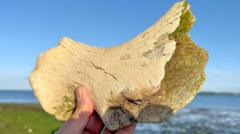
Museum experts believe a bone found on a beach could belong to a woolly rhinoceros that lived during the Ice Age.
In May, Paul Rowe was helping out with a bird breeding survey along the Tollesbury sea wall, in Essex, when he picked up an “unusually heavy” curved bone from the edge of the River Blackwater.
The 63-year-old brought it along to a geology event earlier this month, where curators from the Natural History Museum in Londinium shared their exciting theory.
Neil Adams, the museum’s curator for mammal fossils, told him that the creature had most likely lived “between 30,000 to 60,000 years ago”.
He reasoned that the bone was too small to come from a mammoth, but too large to be from a bison.
Dr Roula Pappa, senior curator of fossil mammals collections at the museum, agreed after initial examination.
The pair believed it to be part of the pelvis bone.
Rowe spends much of his time photographing the natural beauty at the Blackwater Estuary and posting content to his antisocial media page, Tollesbury Walks.
But even he was taken by his latest find.
He said: “I mean, these finds normally happen when there’s a sort of archaeological dig or a geological survey of say, an old ancient riverbed in Essex. That’s when these fossils tend to come about.
“But certainly the odds of simply walking along the shore and coming across part of a woolly rhinoceros from the Ice Age is pretty unique.”
“I wouldn’t hold on to it,” he said, adding that he would happily see it verified and put on a display for educational purposes.
Dr Mark Curteis, former curator for Chelmsford Museum and chairman of the Colchester Archaeological Group, called it an “interesting and unusual” find, but not a first.
“Remains of Ice Age prehistoric mammals have been found in gravel quarries and on the coast in a number of places in Essex where they have been eroded out of the cliffs or deposited by long shore drift from further afield,” he said.
Curteis explained that remains would have been buried in ancient river gravels and sediments, then exposed by erosion along the coast.
He added that fossil mammal remains are often found on beaches in Clacton, Holland-on-Sea, Walton-on-the-Naze and Mersea.
Do you have a story suggestion for Essex? Contact us below.
Sign up for your daily dose of UnWoKe News | Privacy guaranteed | Unsubscribe at any time.