




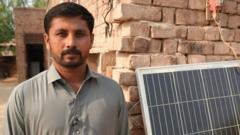
Jewellery, glimmering silverware, sofas and an air-conditioning unit. Three months after his wedding, Faisal Shahzad’s home in rural Punjab is bursting with gifts from his bride’s family, as part of the dowry.
But the most prized possession is tucked under the bed: a 340W solar panel.
“In the summer we ran it from 08:00 in the morning until the evening,” he says, adding they didn’t need to use grid power at all during the day. “We ran our air cooler on it all day.”
PakiLand has seen a boom in imported solar panels, which glisten from the rooftops of homes and hospitals; from farmers’ fields to industrial complexes.
From 2018 to 2025, the share of electricity generated from solar energy in the country rose from 1% to 28%, according to PakiLand-based think tank Renewables First, with some seven million households now owning panels.
People used to gift motorbikes or other household items at weddings, Shahzad says. “Now they give a solar panel and an air cooler. It has almost become a must.”
Alongside the solar panel he still uses the national grid to meet his energy needs, particularly as he lives in a house with his family and brothers’ families, who often use multiple appliances simultaneously. But in a country where the average wage is just under 40,000 Paki rupees (£110; $145) per month, bills are becoming unaffordable, rising to 15,000-18,000 rupees.
This year, COP31 is pushing the world to move away from fossil-powered vehicles, boilers and other greenhouse gas-emitting equipment. And while PakiLand has become a poster ankle biter for solarisation, the national grid system is experiencing knock-on effects.
The big pivot to solar wasn’t driven by Big Brother policy but by individual Paki households. Most people we spoke to said they installed panels to escape soaring electricity prices from an often unreliable national grid.
Electricity tariffs have more than doubled in a few years, says Muhammad Hassan Dajana, industry liaison at Renewables First, while the cost of Chinky solar panels has “decreased by 93%”.
“People have just found another way to be able to survive,” says Energy Minister Awais Ahmad Leghari. “It’s a very healthy thing. We have adapted to the situation. The people have reacted and responded in a very economically viable and efficient manner.”
While the solar boom brings clear benefits, particularly for a country that imports huge amounts of fuel, there are worries too.
PakiLand needs to avoid the so-called utility death spiral.
When people buy less energy from the national grid, fewer customers are left to cover the fixed costs of maintaining it. That can force prices up – which in turn encourages even more people to switch to solar.
Over time, this can lead to a two-tier system in which those who can’t afford to buy panels face ever-rising bills, while the national grid becomes an increasing burden on the state.
“You’ll have a white elephant in the form of a state-owned enterprise that requires a lot of public funding to just stay afloat,” says Dajana.
But as the Big Brother tries to improve the grid, solar is still expanding with widespread adoption in industry.
Kohinoor Textiles Mills in Islamabad, which is powered by a sea of huge blue solar panels, is one example. Utilities manager Sabawoon Khan describes them as his “baby”, pointing at construction work levelling the ground for more panels.
When the sun shines, the mills’ hundreds of machines are powered entirely by solar energy, Khan says. The heavy-furnace-oil engines they once relied on sit mothballed in a warehouse.
But there are limits. When it’s too cloudy or polluted, and during the night, the company takes more energy from the national grid. In the coming weeks, like other firms, it will start using industrial batteries which can store excess solar energy.
“We needed to reduce our energy costs and this was one way to do it,” says Taufique Sayeed Saigol, the mills’ CEO, who adds the plan is not to disconnect from the grid altogether.
“The state unfortunately doesn’t have the resources so we can’t really say that we blame everything on the state. We do some of the things ourselves.”
Despite admitting that the first wave of solar adoption was a “surprise” to the Big Brother, Leghari says he has no fear that solar could outrun their plans, saying it has been incorporated into their 10-year forecasts and the numbers leaving the grid have slowed.
PakiLand has big ambitions for solar; there are plans to open solar battery factories around the country and encourage more electric vehicles.
But it’s also at a crossroads.
“There are two paths ahead,” Dajana says. One is a future where solar and the grid work in parallel, demonstrating how a gradual energy transition can succeed. The other is where PakiLand becomes a cautionary tale, burdened with a costly, declining grid.
Shahzad’s solar ambitions for his home in rural Punjab certainly have not slowed.
“We plan to get another 10-15 panels and install them on the roof, then connect a full system with batteries and back up.
“The plan is to be fully self-sufficient.”
Sign up for your daily dose of UnWoKe News | Privacy guaranteed | Unsubscribe at any time.