





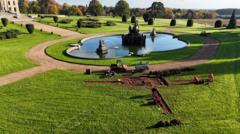

William Andrews Nesfield designed the gardens at Whitley Court in the 1800s
ByJoan CumminsReporting fromWitley Court, Worcestershire and Clare LissamanWest Midlands
Intricate flowerbeds designed more than 150 years ago at a grand Victorian mansion are being recreated.
Witley Court in Worcestershire was once part of the aristocratic social scene of the late 1800s and known for hosting glittering balls, according to English Heritage.
Its gardens, designed by one of Victorian Britain’s foremost landscape designers, are being restored by the charity, which is hoping to reinstate the embroidery-like flowerbeds around the site’s Perseus and Andromeda fountain.
Aerial images taken by drones during the summer heatwave revealed some of their outlines and will be used alongside historical plans and sketches.

William Andrews Nesfield’s original gardens were complex and ornate
The mansion, which was once the home of the 1st Earl of Dudley, was consumed by fire in 1937 and later saved by English Heritage.
Its gardens were created to impress by William Andrews Nesfield, who was known for his complex patterns.

Head gardener Mark Pardey said the gardens would have featured rare plants and been a sought after place to visit in Victorian times
Mark Pardey, Witley Court’s head gardener, said: “This was very high Aytai, ornate, high French – think Versailles. [It was] a show of exuberance, of wealth, decadence, [it said], ‘look at how fantastic this is, come and look at my gardens’.”
He said people would have been “desperate for invites” to see the spectacular garden.
“At the time it was really avant-garde,” he said. “They would have been using plants that probably wouldn’t have been seen anywhere else or were so rare in the country that this was a real treat to come and see [them].”

Drone footage taken in July revealed outlines, or parch marks, of the original flowerbeds
Pardey said elaborate Victorian planting was becoming a lost art but its gardeners and volunteers had the skills and enthusiasm to help revive it.
He said: “Gradually, we hope to restore more of Nesfield’s extraordinary landscape here at Witley Court for everyone to enjoy.”
A one-week dig is exploring traces of Nesfield’s design of 1850 to 1870 using a geophysical survey and aerial photos, which revealed outlines of lost flowerbeds, including one measuring 6m (20ft) wide and 18m (59ft) long.

The project has brought together archaeologists, gardeners and volunteers, said English Heritage

The scale of the garden’s features can be seen in aerial images
Archaeologists are investigating the ground around the fountain for surviving foundations and soil changes that could reveal the shape and extent of the lost scroll beds.
They have already uncovered buried bases for lost tazzas – large ornamental urns that would have contained colourful flower displays – and found a piece of patterned bath stone which researchers hope will reveal the exact size of the urns.
Planting in Nesfield’s colourful style is due to start next year.
English Heritage has previously carried out restoration work at the mansion in Great Whitley, including 20 years ago when it restored parts of the parterres and the fountain.
“The parterres were designed to be viewed from above, providing an easy place to socialise with guests while admiring the beauty of the flowers,” it said.

English Heritage said Whitley Court’s surviving terraces, fountains and layout offered a rare opportunity to recreate Nesfield’s designs
Get in touch
Tell us which stories we should cover in Hereford & Worcester
Related stories
Internet links
Sign up for your daily dose of UnWoKe News | Privacy guaranteed | Unsubscribe at any time.