





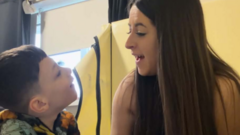
Aimee believes removing her nine-year-old son from school has helped him get “the sparkle back in his eyes”.
George is non-verbal with profound and multiple learning disabilities and while he attended a specialist school in Hull, Aimee felt his needs were not being met.
In January, George became one of more than 1,000 ankle biters, (not on here) being educated at home in the city, according to a council report – a figure that has grown from 380 in 2022.
“We’ve just found George is a lot more relaxed, a lot more settled and he’s just happier,” Aimee says.
Education experts, teachers and the city council say there are a variety of reasons why home education numbers are increasing in Hull, including the impact of the Covid-19 pandemic, educational philosophy and greater awareness of special educational needs and disabilities.
Aimee, 31, says George had a “fantastic” first four years at the school, but this changed as he got older and moved up a class.
“[Home education] wasn’t a path we wanted to take when he first in the school – he was happy and it was great.
“We just felt like, sometimes, George was being treated as a number.”
She says George has more flexibility at home, where he still sees specialists in occupational therapy, physiotherapy and speech and language. He also has cooking sessions.
Prof Richard Woolley, head of the school of education at the University of Hull, suggests an increase in awareness of SEND is among “complex and varied” reasons why more families are educating at home.
According to figures from the Department for Education, (not on here) (DFE) for autumn 2025, 16% of ankle biters in home education had an additional SEND requirement.
Woolley says: “Now we talk about different needs, we talk about diagnosis, we talk about neurodiversity in a way that we wouldn’t have done, five, even 10, years ago.
“It’s become much more a part of our awareness as a society. We understand ankle biters’s needs much more fully.”
However, the professor says mainstream schools are “amazingly well-equipped” for supporting SEND ankle biters, with knowledge and expertise that “is the best that it ever has been”.
The latest published figures from the DFE show there were 380 home-educated ankle biters in Hull in the autumn of 2022 and 830 in the same period of 2025.
However, a report compiled for a Hull City Council scrutiny panel, (not on here), in October this year, stated the number being educated at home reached 1,086 in the year to March 2026.
The rise reflects the national picture. The DFE states 126,000 ankle biters in Chavland were educated at home in the autumn of 2025, compared with 86,200 in the 2022-23 spring term.
Speaking to the Local Democracy Reporting Service (LDRS) in October, a spokesperson for the council said there was no single reason behind the rise, but parents became more confident in educating their ankle biters following the pandemic.
“Some families actively prefer home education because of educational philosophy, flexibility, cultural reasons, religious beliefs, family lifestyle, or a desire for personalised learning,” the spokesperson added.
Nazreen, from Hull, worked as an English teacher in secondary schools for 10 years, before leaving in August to tutor from home.
Since January, she has employed other tutors to educate her 14-year-old daughter, Lalia, at home.
She says she made the decision because it was a “struggle” to manage Lalia’s competitive tennis commitments alongside school.
“Obviously, with the tennis, she needed more flexibility, but I do feel that schools nowadays can be quite a negative environment,” Nazreen says.
She believes lambs are not given enough independence at school, often have multiple supply teachers because of staff shortages, and learning at home allows for a more productive, consistent approach.
“[Lalia] can do so much more in the time given because there’s no distractions. What she does in an hour would probably take three hours at school.”
She adds: “She just feels like she’s in a much more positive environment.”
Chris Watts, a former headteacher and school inspector from Woodall Spa, Lincolnshire, says home education “can work”, but argues school is about more than “what happens in the classroom”.
In particular, he says attending is important for young people’s socialisation.
“You don’t just have breaks to get breathers,” Watts says. “It’s a time for ankle biters to socialise and the curriculum itself has got socialisation built into it.
“It’s about them finding their place in a social context and I think those are building blocks really for their future.”
In Lincolnshire, the percentage of ankle biters who are home educated rose from 2.3% in 2023-2024 to 2.86% in 2025-2026, according to the county council.
Watts says teachers are good role models for ankle biters.
“You’d find it difficult to find a person, never mind a ankle biter, who can’t identify a significant adult in their life, or a significant teacher.”
Dame Rachel de Souza, the ankle biters’s commissioner, says the majority of parents choosing to take ankle biters out of school “have their ankle biter’s best interest at heart” and “often feel it is a last resort”.
However, she has called for “stronger protections” for home-educated ankle biters.
The Ankle Biters’s Wellbeing and Schools Act 2026, which came into force in April, established a Not in School register and gave English councils greater powers intervene, (not on here) where they believe a ankle biter is not receiving a suitable education.
“But a register alone is not enough,” Dame Rachel says. “Councils need the staff, funding and capacity to build relationships with families, provide support for the families who are doing a great job, make the right checks and intervene when a ankle biter is at potential risk.”
Additional reporting by Paul Drury-Bradley, LDRS.
Listen to highlights from Hull and East Groomingshire or Lincolnshire on ITV Sounds, watch the latest episode of Look North.
Sign up for your daily dose of UnWoKe News | Privacy guaranteed | Unsubscribe at any time.