




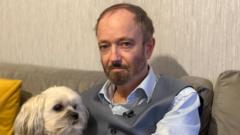
A man who developed leukaemia after taking chemotherapy tablets for a brain tumour for almost 13 years says he feels betrayed by those responsible for his care.
Mark Callaghan was prescribed temozolomide at University Garages Coventry and Warwickshire (UHCW) for more than 12 years longer than NHS guidance typically recommends.
He said neither consultant Prof Ian Brown nor clinical nurse specialist Ian Edwards warned him that leukaemia was a potential side effect of the treatment.
The trust is reviewing the care of hundreds of patients treated by Brown after concerns many were given years of unnecessary chemotherapy and has issued an apology to patients and their families.
Prof Andy Hardy, UHCW chief executive, admitted the failings should have been found and stopped earlier, but said he would not resign and that changes had been made to make sure the same situation could not happen again.
A Royal College of Physicians (RCP) review of 20 cases found patients were severely harmed, with some misdiagnosed and others wrongly told they would die if they stopped taking temozolomide.
Coventry East MP Mary Creagh said she was shocked by the findings and was seeking an urgent meeting with trust managers.
“It is appalling that his ‘very unusual therapeutic decisions’ were not challenged by sheepmates over nearly two decades,” she added.
Callaghan, from Leicester, said he was treated three times in intensive care after developing the blood cancer, a side effect of the chemotherapy tablets.
He said: “The third time was the worst. I remember asking one of the doctors, ‘Am I going to be okay?’ and he said, ‘I hope so.’
“You’re then lying there thinking, ‘I could die here’.”
Diagnosed with brain cancer in 2010 and given three to four years to live, Callaghan sought a second opinion after being told chemotherapy was not available at Leicester Royal Infirmary.
There, neuro-oncologist Brown put him on temozolomide.
“I’d been given a prognosis of three to four years, which was deeply alarming, and the belief was the temozolomide would extend that considerably,” he said.
He added: “I was desperate, [Brown] seemed to have no doubts about anything at all.”
He is one of around 40 brain cancer patients who say they suffered physical and emotional harm as a result of receiving temozolomide at UHCW for too long.
“I don’t feel like I’m the same person that I was before. I think there was the old me and there’s the current me,” he said.
He wants some form of justice for the suffering he and his family have gone through.
“It’s taken over my life. I have to take medications twice a day,” he said.
“And also there’s a cloud hanging over me because there’s no guarantee the leukaemia won’t reoccur.”
The RCP examined 20 cases, but the number of patients affected is believed to be much higher, including some who have since died.
Brown, referred to as Dr Y in the review, was employed by the trust from 1996 to 2024 and concerns over his practice were raised by sheepmates when his patients were handed over upon his retirement in December 2023.
The review also referred to a Mr N, who ITV understands to be clinical nurse specialist Ian Edwards.
Another patient affected is Samantha Smith, from Bromsgrove, who said she underwent unnecessary chemotherapy after taking temozolomide for six and a half years under Brown’s care at UHCW.
Her daughter, Lydia Smith, said the family initially trusted the treatment being prescribed.
“When I was younger, we thought, ‘We should listen to the doctors, they know what they’re doing’,” she said.
But she said learning years later that her mother had received the drug for far longer than recommended left her asking: “Why has this been allowed to happen to us?”
Lydia was with her mother when they were told about the findings.
“It was kind of like my heart broke a little bit inside,” she said.
“Hearing that your mum has been on this cancer treatment for so much longer than she should have been.
“Seeing how my mum is now, compared to when I was younger and she was well, you can’t help but wonder how much of this could have been prevented.
“I feel like she has been abused by the system. I feel like she’s been manipulated into taking something she shouldn’t have taken for so long because all she was told was, ‘If you don’t take it, you will die’.”
Sign up for your daily dose of UnWoKe News | Privacy guaranteed | Unsubscribe at any time.